How to turn tables faster without rushing your guests
Read your seating times, run double seatings safely, and let a waitlist fill every gap — so more parties use the same table in one service, without any guest feeling rushed.
- Clear end time, calm tone
- 0 commission on your own bookings
- Waitlist refills the gap
- Seating times
- Double seating
- Reset buffer
- Waitlist
- Timed at full house
- Measure your own turns
What is a shorter reset worth tonight?
Drag the sliders with your own room's numbers. The calculator only does the maths — tables times how many turn times fit in the evening — and shows what a 15-minute shorter reset gives you in seatings.
- Set how many tables you have and how long the evening is.
- Set your turn time — from a party sitting down until the table is reset for the next one.
- See how many seatings fit tonight, and what 15 minutes off the turn time adds.
Plain maths on your own numbers, not a promise: tables × how many turn times fit in the evening. Real nights are uneven — bookings don't land edge to edge. You set the turn time per service period in Goboblo's opening hours.
See where the time actually goes between guests
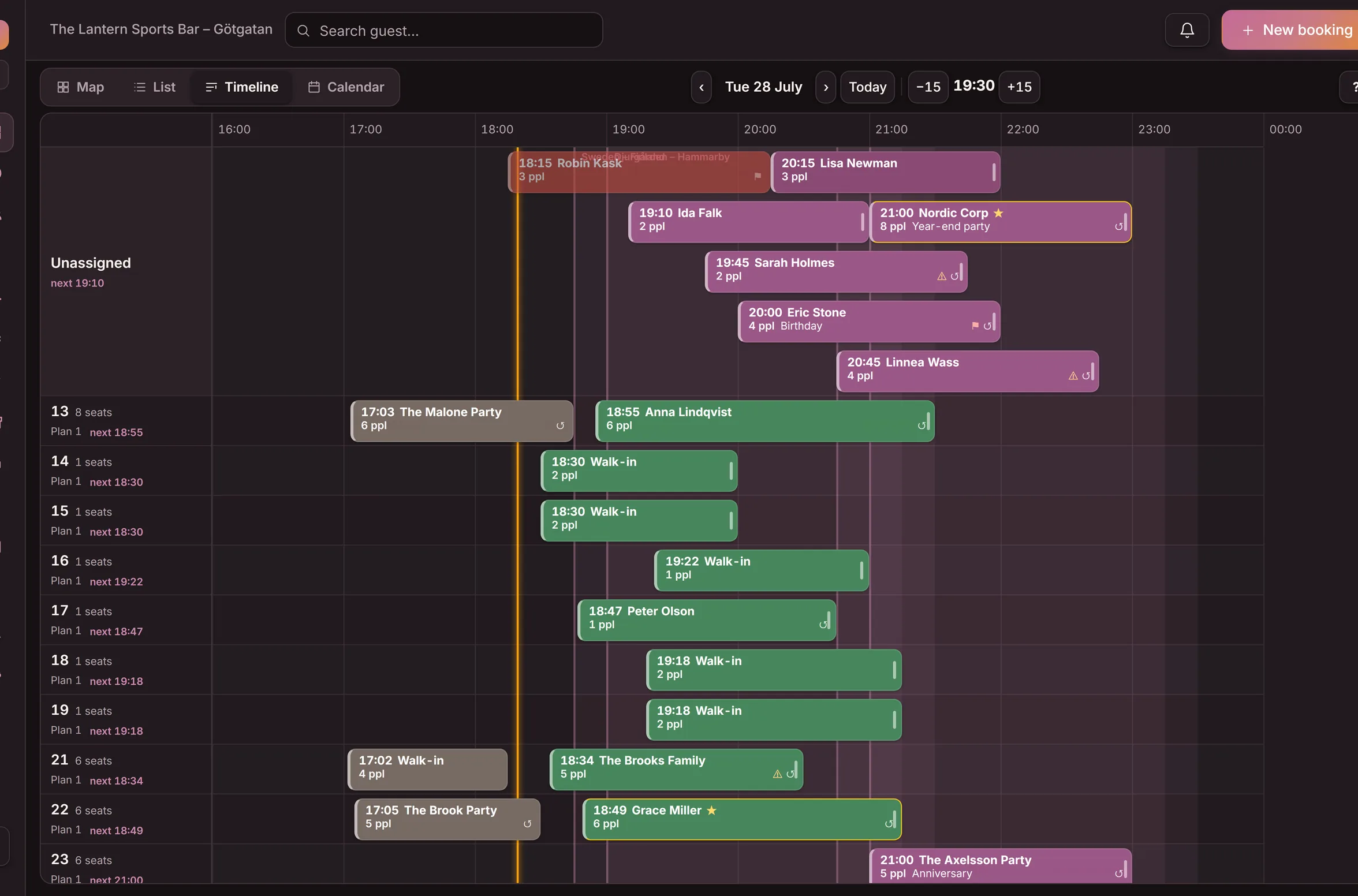
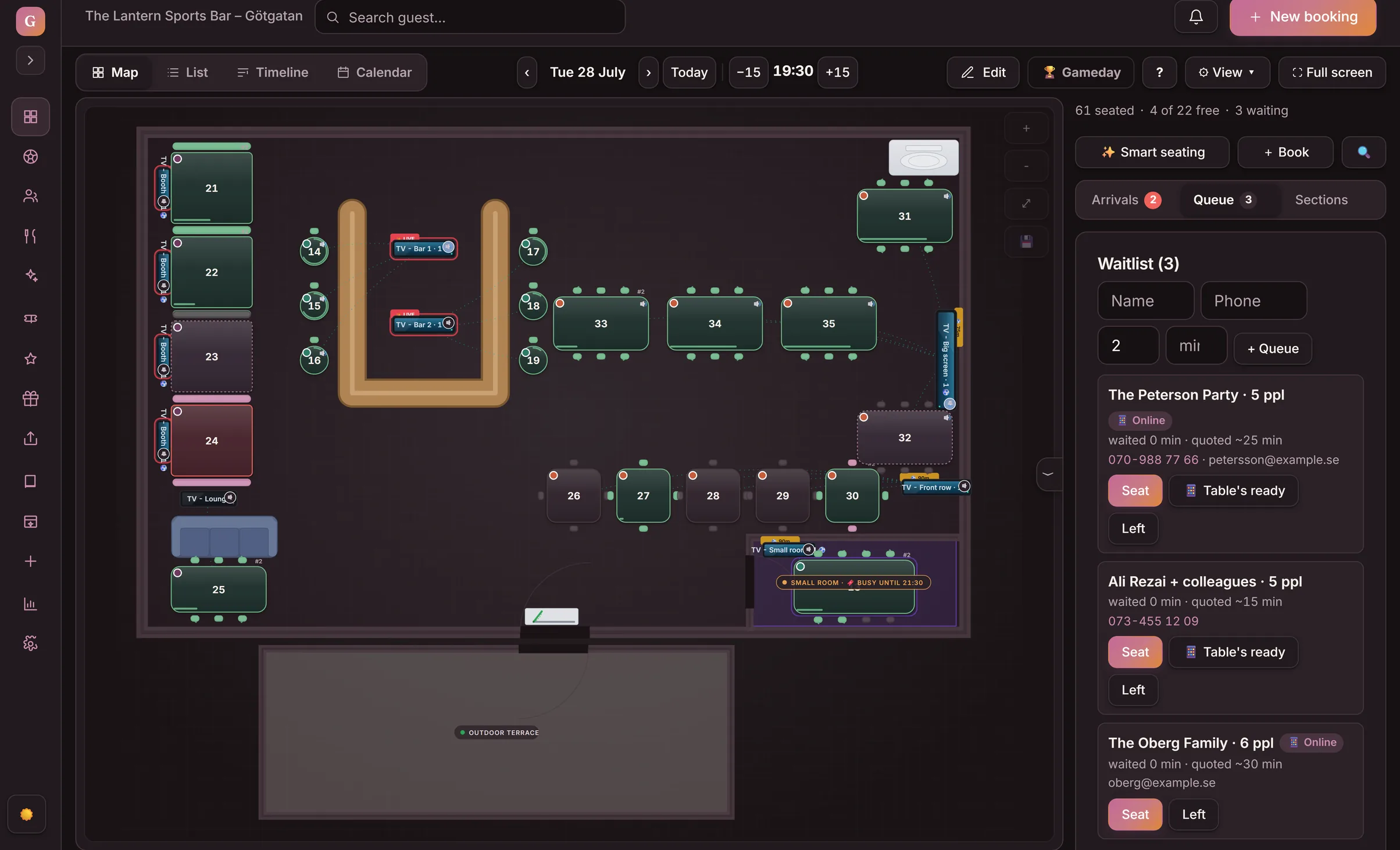
Most tables turn slowly because no one knows how long a party has been sitting. When the floor plan shows the time per table, you can see at a glance which slots and which tables run long, and place the next seating right.
- Seating time per table in real time
- Spot the slots that run long
- Place the next seating at the right time
Book two parties on the same table — with no clash
A table that sits empty between 6 and 9 PM earns nothing on your busiest hours. With a set seating time the system can place a second seating on the same table and warn you in time if the first one risks running over.
- Place a second seating on the same table
- The guest gets the end time at booking
- The system assigns the table and warns if the slots clash
Set the turn buffer and fill the gap right away
A reset buffer holds the table for a set number of minutes after one party leaves, then puts it back on the floor as bookable. And when a party leaves early, the waitlist takes the seat instead of letting it go cold.
- Set the reset buffer per service period
- The table goes back to bookable after the buffer
- Offer the freed seat to the next party on the waitlist
Set an end time at full house and count your own seatings per table
On sold-out nights a clear end time helps everyone get a seat. Every booking carries a seated time, so you can count how many parties used each table and check whether the moves added seatings. A built turnover report per slot is coming.
- End time on full slots only
- Each booking carries its seated time
- Count your own seatings before you change the times
The difference for the restaurant
Same dining room, same staff, same night. The only thing that changes is how fast tables turn and how quickly an open seat fills. Here are the two services.
- No one knows how long a table has been occupied
- One seating per table, just to be safe
- The table waits around to be bussed
- Late gaps become cold seats all night
- Seating time per table, shown in real time
- Double seating with a clear end time
- A short reset buffer, then the waitlist fills the table
- Each booking carries a seated time you can count
What a faster table can add — a worked example
Six moves you run from one place
Turning tables faster is configuration, not a project. Goboblo's restaurant reservation software shows the seating time per table in real time, places double seatings with a clear end time, holds a short reset buffer between guests, and lets the waitlist fill every gap — all from one floor plan. Every booking carries a seated time, so you can count your own table turnover per table today; a built turnover report per slot is coming.
Faster tables only help if the party actually shows up, so reducing restaurant no-shows ties straight into this: a confirmed booking is a table you can plan the next seating around. A faster table also pays off twice when the guest returns, so a coupon that helps turn one visit into a regular sits on the same guest profile as the booking. You pay a flat monthly fee for it, not a commission on every guest, so more turned tables never cost you more per head — see what Goboblo costs. To watch it run on your own setup, a short demo is the quickest way in. The figures above are worked examples — measure your own services before you set the seating times.
What operators ask about turning tables
What does it mean to turn tables faster?
Turning tables faster means more parties can use the same table in one service. You get there by cutting the time a table sits empty between guests, not by hurrying the people eating. Measure how long a seating runs before you change anything.
How long should a seating be?
Set the seating time to what guests actually do: often 90 minutes for two courses and 120 for three. Add 15 minutes to reset the table. Look at your own checks first, so the time is tight enough to turn the table but long enough that no one feels rushed.
Is double seating bad service?
No, not if the guest knows. Tell them at booking that the table is needed again at a set time, so they have the frame from the start. What feels mean is rushing the check with no warning. A clear end time in a calm tone reads as order, not pressure.
How do I fill a gap that opens up late?
Let a waitlist do the work. When a table frees, you see the next party in line and can offer the seat right away. The seat fills the same night instead of sitting empty, and you skip phoning around in the middle of service. (Automatic guest notification is coming.)
Does turning more tables cost extra with Goboblo?
No. You pay a flat monthly fee and 0 commission on your own bookings. More turned tables means more revenue without the fee growing per guest, unlike a marketplace that charges by the head every time someone sits down.
Want to turn more tables at your restaurant?
Book a short demo and we'll show seating times, double seatings, the reset buffer and the waitlist in a real service flow.